
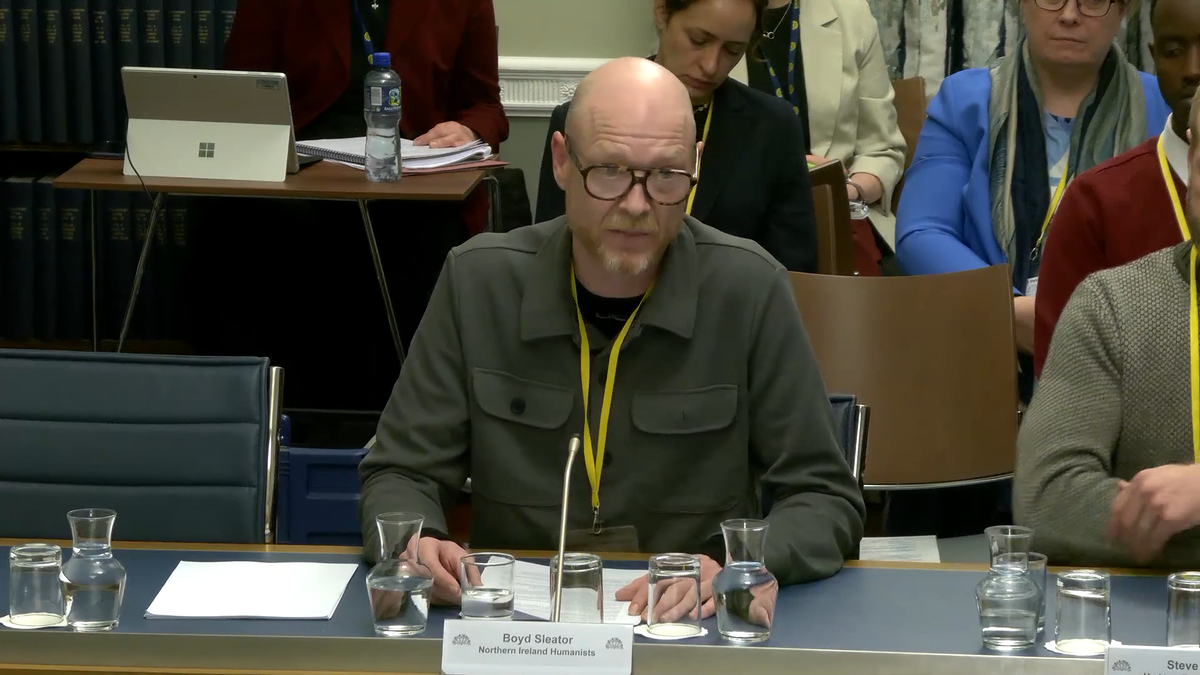
Northern Ireland Humanists has told MLAs that the Conversion Practices (Criminalisation) Bill protects freedom of religion or belief without allowing it to become a justification for harmful practices. Northern Ireland Humanists Coordinator Boyd Sleator gave oral evidence today to the Northern Ireland Assembly’s Committee for Communities, which is scrutinising the Bill.
He gave evidence alongside Mandy Cooke, a therapist specialising in religious trauma, from Christians for an End to Conversion Practices, and Steve Ames, Minister of Harbour Faith Community.
The Private Member’s Bill was introduced by Alliance Party Deputy Leader Eóin Tennyson MLA. It would criminalise attempts to change or suppress a person’s sexual orientation or gender identity. It passed its Second Stage in September and is now at Committee Stage.
Boyd Sleator told the Committee that there is clear evidence of harm, including in Northern Ireland:
‘A parent, minister, or counsellor should not be criminalised simply for expressing a view. Equally, religious language should not turn an otherwise harmful and coercive conversion practice into something exempt from scrutiny. The law should focus on what was done, the intention behind it and, where required, the harm caused.
‘We believe the Bill strikes this balance well. It explicitly protects the expression of religious beliefs and allows for genuinely open-ended conversations in which individuals can explore their sexual orientation or gender identity. What it distinguishes from those conversations is an intervention intended to direct someone towards a predetermined outcome.
‘The Bill does not seek to regulate what people believe, but how they act towards others. It ensures that freedom of religion or belief is protected without allowing it to become a justification for harmful practices.
‘We ask MLAs to keep victims and their experiences at the centre of their scrutiny, to consider how the legislation can help victims access justice, and avoid creating further barriers for them, and to ensure that abuse cannot hide behind the right to freedom of belief.’
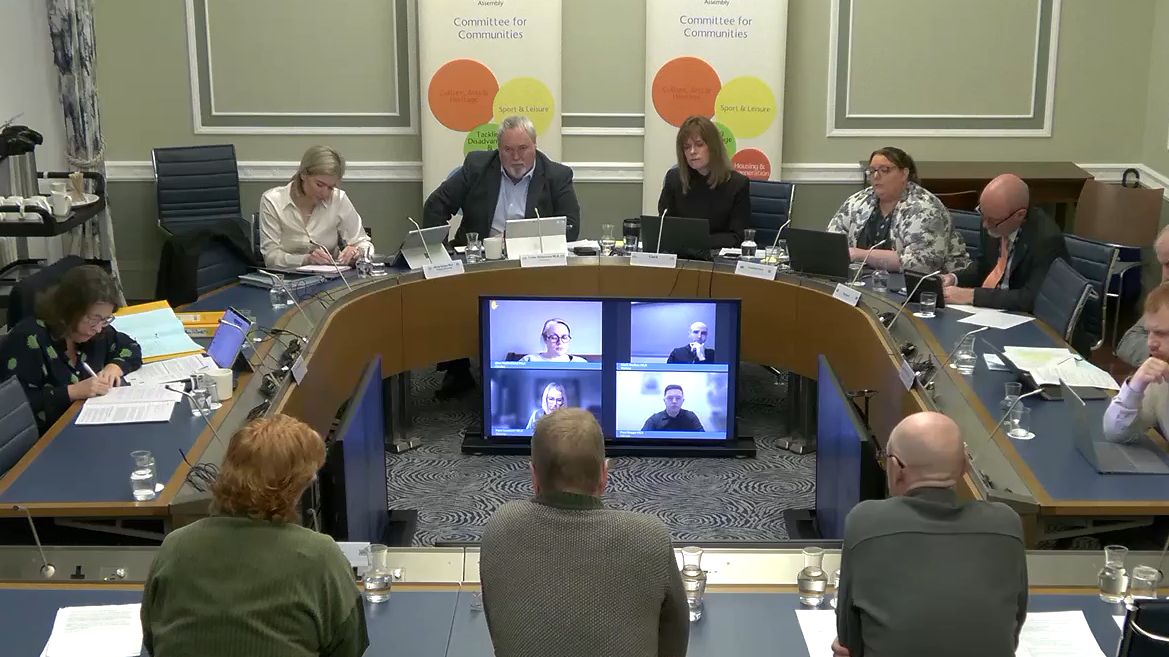
Mandy Cooke, a therapist specialising in religious trauma, from Christians for an End to Conversion Practices, told the Committee:
‘I see how these practices damage people’s relationships, their careers, their mental health, and their spiritual wellbeing. For many, the weight of this has felt so unbearable that it has led to severe mental health crises and profound psychological distress. Sadly, I have no doubt that many more have suffered in silence, taking their secrets to the grave.
‘At the heart of this harm is profound toxic shame. Conversion practices do not just target a behaviour; they teach a person that their core identity, the very way they love and exist in the world, is inherently broken or offensive to God. And when you internalise that message, it fractures your sense of self. It leads to chronic anxiety, depression, dissociation, and an inability to trust your own instincts or form safe, intimate relationships.
‘It is not merely a disagreement over theology; it is psychological harm because it strips away a person’s basic sense of worth. We are here today to challenge the narrative that this Bill is anti-Christian, anti-religious, or a threat to religious freedom. There is one version of Christianity that has a very loud voice in this debate, but it is by no means the voice that speaks for us all. I’m honoured to represent those whose faith actively leads them to support this Bill.’
Steve Ames, Minister of Harbour Faith Community, shared the wording of a prayer from a manual for a deliverance ministry that was used if homosexuality was identified:
‘Lord Jesus, I renounce the lie that you have created me or anyone else to be homosexual. I renounce all homosexual thoughts, urges, drives, and acts and renounce all ways that Satan has used these things to pervert my relationships.’
Steve Ames told the Committee:
‘Calling those words a prayer does not change what they ask a person to do. They ask someone to renounce their homosexual thoughts, urges, and drives. That is an attempt to suppress sexual orientation. The religious setting does not make the potential harm any less. In fact, it may well amplify it. And this kind of ministry itself was and usually is well-intentioned, but directed homophobia moulded into the form of a prayer is still homophobia, and the harm that results is still real.
‘I support this Bill because I have seen the human cost of that pressure. I’m not asking the Committee to treat every prayer, conversation, or expression of belief as an offence. I’m asking you to look honestly at what a practice actually asks of a person, what it’s intended to do, and the harm that can result.’
Once the Committee has reported, MLAs will debate amendments to the Bill at Consideration Stage.
Notes
For further comment or information, media should contact Northern Ireland Humanists Coordinator Boyd Sleator at boyd@humanists.uk or phone 07918 975795.
Read more about our work on ending conversion practices.
Northern Ireland Humanists is part of Humanists UK, working with the Humanist Association of Ireland. Humanists UK is the national charity working on behalf of non-religious people. Powered by over 150,000 members and supporters, we advance free thinking and promote humanism to create a tolerant society where rational thinking and kindness prevail. We provide ceremonies, pastoral care, education, and support services benefitting over a million people every year and our campaigns advance humanist thinking on ethical issues, human rights, and equal treatment for all.